
Tuesday, October 20, 2026

Monday, October 5, 2026
reposted from Rachel Barber and Jessica Guynn
Oct. 2, 2026, 5:05 a.m. ET
JOBS & LABOR
There's still a heavy demand for workers. It's in blue-collar jobs
White-collar workers in AI-exposed fields are looking at the skilled trades and asking themselves whether they made the right career choice.
New research suggests it may be reasonable for them to wonder. Americans fear AI could lead to job losses, so they're looking to fields they think are more secure.
Demand for workers in the skilled trades remains substantial and the pipeline of new entrants is not keeping pace as older workers retire, according to a new national report from the Alliance for America's Skilled Trades.
If that demand is not met, Ford CEO Jim Farley said Americans may start to notice the worker shortage. It'll start small. A local highway may take longer and cost more to build. An auto technician shortage could mean drivers face longer wait times when getting their car repaired.
But, when a plumber or electrician is needed at a water-treatment plant, or to keep an ambulance running in an emergency, their absence could have "life or death" consequences, he said.
The demand for skilled trade labor and the future of work are topics of conversation in the Farley household. Despite being a multimillionaire executive, Farley encouraged his teenage son Jameson to learn to work with his hands after he told his dad he didn't see a need to go to college. That comment sparked a debate, but the pair landed on a solution: Jameson would learn to weld in the summer and go to college. On the weekends, he's working as a race mechanic — something he probably looks forward to more than his business administration classes, Farley said.
"The air we breathe is a four-year degree," Farley said in an interview with USA TODAY.
He is one of several industry leaders trying to "break this myth" that attending college to prepare for a corporate 9-to-5 is superior to a career in the skilled trades. Hands-on work "awakens something that's kind of pretty self-evident that we've lost as a society," Farley said.
"Let's treat the uncertainty that these kids have now with getting a job after college the right way, which is to reconfigure things," he added.

Demand for skilled trades workers
While the definition of "skilled trades" can vary, Matt Sigelman, president of the Burning Glass Institute, said researchers define it as work that is hands-on, physical, and requires meaningful preparation.
Of 124 occupations that fall into that category, demand for workers in 86 is expected to either grow or hold steady over the next decade, the Alliance for America's Skilled Trades report said. It estimates that employers will need to fill about 1.7 million openings each year through 2035.
Researchers estimate there will not be enough workers to meet that demand. Roughly 55 people are being prepared for every 100 workers needed nationally, they said. A Labor Shortage Index included in the research found that workers are most in demand for jobs including mechanics, maintenance workers, millwrights, electricians, carpenters, HVAC mechanics and installers, plumbers and automotive service technicians.
Demand for skilled trade laborers exists across the country, but it varies based on the number of currently available workers, training pathways and local labor market conditions. Florida and Arizona face the highest demand pressure, while West Virginia and Michigan face the lowest, the research found.
"There's a lot of workers moving to certain parts of the country where there's more projects or more growth in employment. That's an old story. It makes sense. It bears out in skilled trades just as much as elsewhere," Sigelman told reporters, adding what's interesting is that "these fast-growing states are essentially importing the workers that they're failing to train."
Interest, but a lack of follow through
Worker shortages in the trades may not be due to a lack of interest, but a lack of follow through.
At 71% and 81%, respectively, most teens and parents said they would be proud if they or their child pursued a skilled trade, and 95% of counselors view trade school as valuable and credible, the research found.
Yet it also revealed a minority (28%) of counselors recommend apprenticeship.
Even if a person starts one, only 48 out of 100 complete it and just 29 enter a trade occupation within five years of leaving the apprenticeship. Among those who enter a related post-secondary program, 48 out of 100 finish, and 34 go on to work in a skilled trade.
"The central implication is clear: strengthening the skilled trades workforce requires more than growing the pipeline," Maria Flynn, president and CEO of Jobs for the Future, said in the briefing. "It requires making the pathways, the systems, the guidance, and the investment around that workforce better."
Go to college or enter the trades?
The report lands as some question whether a four-year degree is still worth the cost. Nearly 3 in 5 parents said AI is making school "a worse investment" in a WalletHub survey earlier this year. It also comes as recent college graduates are having a tough time squeezing their way into a labor market economists describe as "low-hire, low-fire."
"For the first time in modern history, a bachelor's degree is failing to deliver on its fundamental promise: access to professional employment," Sigelman wrote alongside researchers Gad Levanon, Mariano Mamertino, Mels de Zeeuw and Gwynn Guilford in a Burning Glass Institute report last year. "The traditional pathway from college to career is becoming less reliable."
As of August 2026, the unemployment rate for people ages 25-34 with a bachelor's degree was 3.4%. For high school graduates of the same age, it was 6.2%, according to federal government data.
What stands out: In August, the unemployment rate among workers of the same age with an associate degree in occupational programs that prepared them for a specific job was 2.2% — nearly half the national rate of 4.1%.
While it does not guarantee job security, it may still pay off to go to college in the long run. Americans' median weekly earnings rose in line with their level of education in 2025, according to Labor Department data.
Laura Ullrich, Indeed Hiring Lab's economic research director, said Americans may not have to choose between going to college or entering the trades.
"Right now, if you live in a place that has data centers and you stacked some sort of credential related to electricity of HVAC or water systems onto a four-year degree, that might be a great combination," she said.
Demand doesn't equal an instant job offer
In high-demand markets across the country, experienced plumbers, electricians and HVAC technicians are fielding aggressive calls from recruiters. The shortage of skilled technicians in those areas has sent starting salaries soaring into the mid-six figures.
For those entering the trades, the long-term career outlook offers job security and a stepping stone. Certified apprentices who master their craft can eventually launch their own businesses.
"There's no doubt in my mind that this is going to be a growing need. We get calls every day from companies looking for talent," Troy Latuff, founder and CEO of the Blue Collar Recruiter, a Texas-based recruiting firm and virtual trade school. said. "The talent that's there today is aging out."
Industry experts warn that entry-level candidates still face a challenging hiring environment. Getting a certification or completing an apprenticeship does not guarantee a job offer.
Equipping and training workers represents a significant financial investment so employers are taking a cautious approach to hiring, according to Latuff.
"You might have the certification, but if you don't show up for your interview, or you're late, or you're not responsible or reliable, you’re still not going to get the job," Latuff said. "There is a big need but it doesn't mean they're going to take anybody that just shows up."

Skilled trades aren't for everyone
The shiny promises of a career in the trades do not always match the hype.
Frustrated by a tight corporate job market, Will Ryan, a 24-year-old with an MBA from the University of Nevada, Reno, decided to switch gears. With skilled trade careers touted as AI-proof alternatives to increasingly elusive entry-level white-collar jobs, he set his sights on becoming an electrician and eventually opening his own electrical contracting business.
The reality of working on a major data center project as a union apprentice proved far different. The pay was decent, but working conditions were grueling. The schedule was relentless with 10- to 12-hour shifts six days a week and little time for the training he'd need to launch an independent company.
Despite two professional degrees and a dual income, the region’s soaring cost of living meant all he and his wife could afford was a studio-sized converted barn on a friend’s property. After six months in the union apprenticeship and a brief stint with a non-union contractor, Ryan walked away from the trade.
"My wife is a biomedical engineer. I have my MBA. I think we both probably would have both been art majors if we knew either way we would end up living in a barn," he said.
How will AI affect the trades?
The AI buildout has created new opportunities for some skilled trades workers as companies construct data centers needed to support it across the country.
While the emerging technology has been painted as a threat primarily to white-collar workers, blue-collar jobs will be affected as well, according to Microsoft co-founder and billionaire Bill Gates.
"Although robots are not as far along as AI, eventually their cost will be dramatically lower, too," Gates wrote in an August essay. "I think 'smart' robots will begin to compete with people on some physical tasks — in the construction and hospitality industries, for example — by the end of the decade."
Farley said it's hard to know exactly what the AI buildout's impact will be on skilled trades work, but Ford is already experimenting with repairing cars using augmented reality glasses to be more efficient, he said.
"But it's just about getting more work done in the eight-hour shift than replacing an auto tech," Farley said, adding he believes skilled trades workers will remain in demand.
Sigelman said one of the things that makes him confident about continued skilled trades demand is that much of the work still requires human judgement.
"The more that we are enabling them to take on highly varied and complex tasks, the more resistant these jobs will be to displacement over time," Sigelman said.
Monday, September 21, 2026
The 2026 CEWD Workforce Development Summit

Save the Date! The 2026 CEWD Workforce Development Summit will be held at National Harbor, November 17-20, 2026.
To stay up to date on registration information, programming, and opportunities to get involved with the 2026 Workforce Development Summit, sign up for CEWD’s Newsletter.
CEWD’s Annual Workforce Development Summit offers a unique platform to find solutions for building the sector’s talent pipeline. For those in the industry and external stakeholders responsible for responding to the historic hiring needs facing the industry, those who support economic development, and pre-hire training, the 2026 Summit will offer an unequalled learning and networking environment. Both seasoned executives and those newly tapped to enhance their organization’s outcomes will find benefit from lessons-learned, thinking partners, voices of experience, and a community of hundreds working toward local actions toward national workforce focused priorities.
Attendees can expect four days of peer learning and data-driven sessions centered on:
POWER SURGE: Energizing Students, Educators, and Classrooms
SKILL READY: Building the Workforce Through Earn and Learn Training Pathways
STRENGTHENING THE BASE: Core Competencies of Your Workforce Development Strategy
WIRED TO WORK: AI, Automation, and Technology in Building the Energy Workforce
The 2026 agenda will deliver the hallmarks of what is expected from CEWD’s annual program, with added structure and offerings to respond to this year’s talent development needs and a showcase of CEWD’s 20th year of service to the industry.
Wednesday, March 4, 2026
North America’s Building Trades Unions Joins CEWD to Strengthening Industry Labor Voice

North America’s Building Trades Unions Joins CEWD Board of Directors, Strengthening Industry Labor Voice
The Center for Energy Workforce Development (CEWD) announced on March 3rd that North America’s Building Trades Unions (NABTU) will now hold a seat on the CEWD Board of Directors, significantly bolstering the labor perspective at the leadership table. Trevor Falk, Special Assistant to the President at NABTU, has been appointed as CEWD’s newest director.
NABTU is an alliance of 14 national and international unions in the building and construction industry that collectively represent over 3 million skilled craft professionals. Their addition to the Board comes at a pivotal moment, as the energy sector faces an unprecedented demand for skilled labor driven by historic federal investments in American energy dominance.
NABTU’s presence on the Board complements the long-standing leadership of the International Brotherhood of Electrical Workers (IBEW), which has served on the CEWD Board since the organization’s inception. The combination of NABTU and IBEW leadership creates a powerful labor voice, ensuring that workforce development strategies prioritize expanded visibility for labor roles, high-quality apprenticeships, and family-sustaining careers.
Thursday, February 12, 2026
Virginia Energy Career Pathways
The Virginia Energy Industry is much bigger and the scope of available careers in Energy is much broader than most realize.

Start here: https://getintoenergy.org/career-pathways/
Monday, January 5, 2026
Energy Fundamentals 2.0
The Center for Energy Workforce Development (CEWD) launched Energy Industry Fundamentals 2.0 program (EIF 2.0), a 120-hour curriculum that educates high school and technical school students about energy and careers within the industry.
Alongside industry educators and representatives from energy businesses, CEWD worked to modernize the long-established EIF curriculum to ensure the preparedness of a skilled, diverse energy workforce. The program aims to provide expanded energy education to 500,000 students over the next 10 years.

The free, virtual course offers units that explore the power of energy. Its labs and interactive exercises connect students with foundational learnings about energy and career opportunities. Students who successfully complete the program can earn industry-recognized credentials with the option of earning additional stackable credentials through the program’s supplemental modules. These credentials provide students with a competitive advantage when applying for internships or jobs.
The EIF course connects with almost all learning management systems. Educators, community-based organizations, and others interested in bringing energy education into their classrooms have complimentary access to the EIF curriculum and its associated resources, including curriculum training support.
EIF 2.0 was created in partnership with CEWD’s energy and community educators: Center Point Energy, Constellation, Duke Energy, Exelon, National Urban League, and PSEG.
To download or learn more about the program, visit https://getintoenergy.org/eif-2-0/. To inquire about education or distribution opportunities, reach out to Kristie Kelley at kristie@cewd.org.
Friday, November 21, 2025
Virginia's Energy Plan
Read more from Virginia Energy Sense at
https://www.virginiaenergysense.org/
Virginia‘s Energy Plan
Virginia’s energy strategy follows an “all of the above” approach that uses nuclear, natural gas, renewable, and new energy sources to fulfill the Commonwealth’s energy needs.
The Commonwealth’s 2022 Energy Plan recognizes the following five principles as part of ensuring energy access for all Virginians:
- Reliability. Ensure that Virginians have access to energy when and where they need it by preserving the reliability of Virginia’s electric grid.
- Affordability. Keep energy affordable and protect Virginians from rising energy prices.
- Innovation. Bring the Commonwealth to the forefront of energy innovation by embracing and incorporating new renewable energy technologies.
- Competition. Provide Virginians with more choices in where their energy comes from.
- Environmental stewardship. Improve the quality of Virginia’s environment and protect the Commonwealth’s natural resources.
Where Your Power Comes From
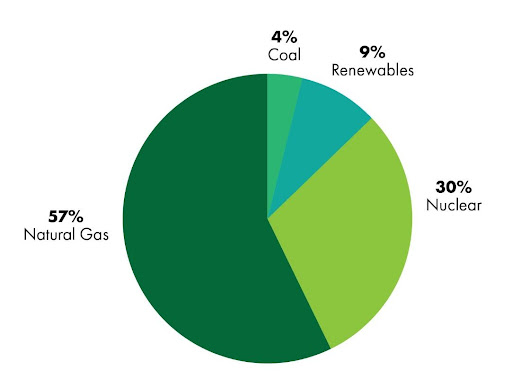
Do you know where your electricity comes from? In Virginia, electricity is generated from a variety of energy sources, including nuclear, coal, natural gas, hydroelectric, renewable, petroleum, and other sources. According to the U.S. Energy Information Administration, most of Virginia’s electricity is generated from natural gas (57%), nuclear (30%), and renewable (9%) sources. The remainder (4%) comes from coal.
Where Virginians Use the Most Energy
- Heating and cooling. This typically constitutes the largest share of energy usage in homes and workplaces.
- Appliances. Refrigerators, dishwashers, and dryers together account for about 20% of all energy used in homes.
- Water heating. This accounts for about 20% of home energy usage.
- Lighting. Lighting represents the largest share of energy usage in the commercial sector and approximately 15% of the average home’s electricity usage.
- Electronics. Demand in this area is increasing because of advanced computer equipment, more sophisticated televisions and streaming devices, and more.
Virginia’s transportation sector consumes the most energy in the state (30.5% of total usage), followed by the commercial sector (26.8%), residential sector (24.2%), and industrial sector (18.5%).
For more information on the Commonwealth’s energy consumption, see the Energy Information Administration’s Virginia profile.
Demand Response Programs
Rising peak demand can strain the electricity system and potentially hurt the power grid’s reliability. Some energy providers have implemented demand response programs, which give commercial and residential
Subscribe to:
Posts (Atom)
Careers in Energy Week Throughout the week, energy companies, educators, workforce partners, and communities across the country are showca...

-
Are Wind Turbines Worth the Investment?: A Cost-Benefit Analysis of Wind Turbines Hannah Burkhardt, Virginia Tech Among alternative energy...
-
Offshore Wind Turbines: What are the Advantages and Disadvantages? The harnessing of wind power dates back to the earliest of sailboats...
-
I've not yet figured out the business model here, but if you complete 3 modules you get full access. Click the image (right) or this li...


