Data Center 101
There are over 300 data centers in Virginia right now, with 241 of them concentrated in Northern VA, and new centers are proposed or approved every day. Loudoun County alone has 117 in the pipeline. It’s little wonder why – the Commonwealth boasts over $9 billion in tax revenue from the data center industry alone. As an economic driver, that is completely unmatched. Legislators and other decision-makers rely on that income for local and statewide endeavors.
As an environmental and energy factor? Not so good. IEA forecasts that energy demand will double by 2030. “In the United States, power consumption by data centers is on course to account for almost half of the growth in electricity demand between now and 2030. Driven by AI use, the US economy is set to consume more electricity in 2030 for processing data than for manufacturing all energy-intensive goods combined, including aluminum, steel, cement and chemicals.”
What does that mean for Virginia, though? Data centers have been hailed as economic drivers, scorned for being environmentally damaging, and feared for their effects on the electric grid. The General Assembly has been slow to move on legislation to regulate the industry, leaving it open to runaway growth.
What is a data center?
Great question. The International Energy Conservation Code defines a data center as, “a room or series of rooms that share data center systems (later defined as HVAC systems and equipment used to provide cooling or ventilation), whose primary function is to house equipment for the processing and storage of data and that has a design total information technology equipment (ITE) equipment density exceeding 20 watts per square foot of conditioned area and a total design ITE equipment load greater than 10 kW.”
The Code of Virginia defines a data center as, “a facility whose primary services are the storage, management, and processing of digital data and is used to house (i) computer and network systems, including associated components such as servers, network equipment and appliances, telecommunications, and data storage systems; (ii) systems for monitoring and managing infrastructure performance; (iii) equipment used for the transformation, transmission, distribution, or management of at least one megawatt of capacity of electrical power and cooling, including substations, uninterruptible power supply systems, all electrical plant equipment, and associated air handlers; (iv) Internet-related equipment and services; (v) data communications connections; (vi) environmental controls; (vii) fire protection systems; and (viii) security systems and services.”
And the American Council for an Energy Efficiency Economy (ACEEE) states, “data center is a general term that can refer to a range of facilities housing computer servers and networking equipment with very different power and market characteristics.”
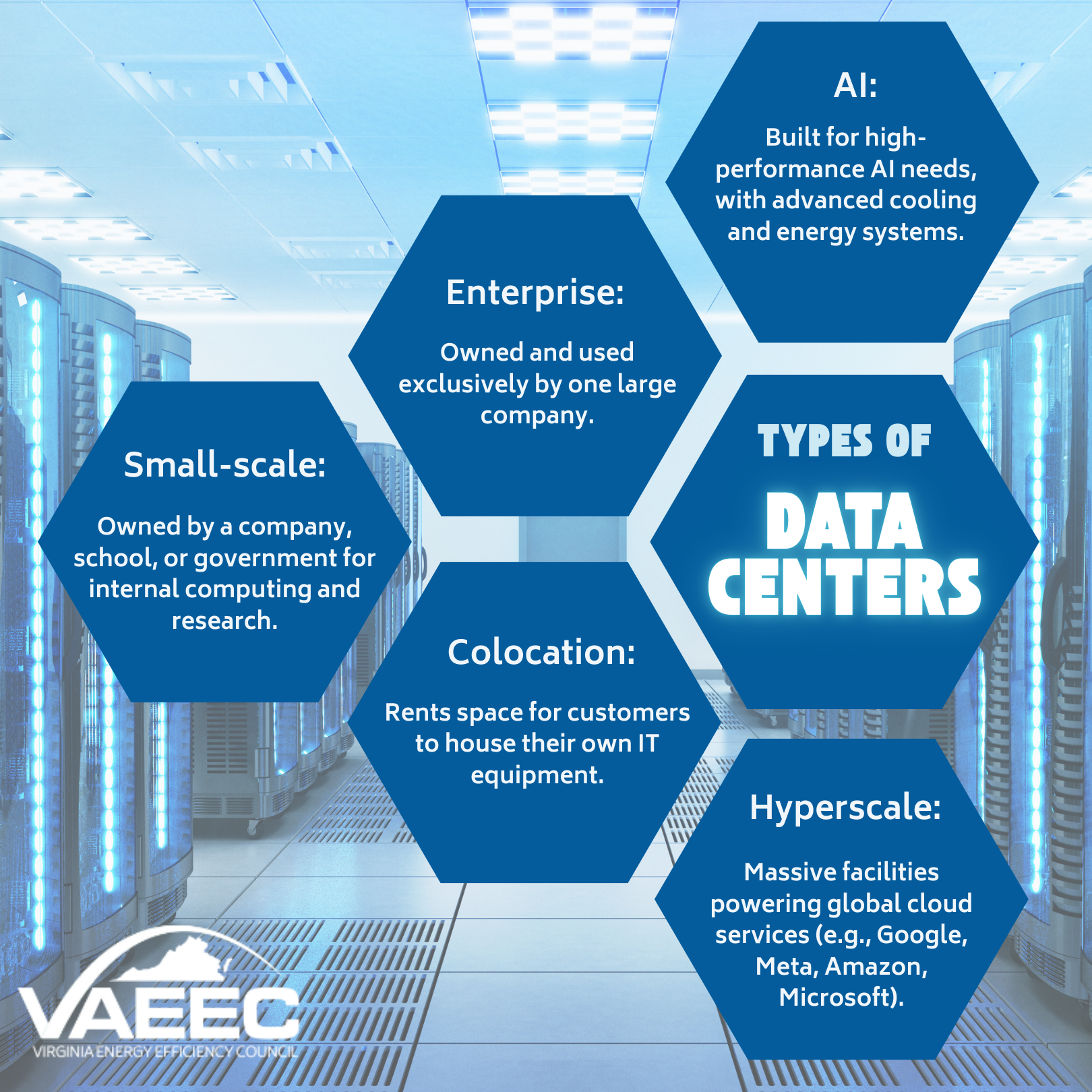
The lack of clarity on what a data center is, makes regulating and legislating the industry incredibly difficult. Moreover, as ACEEE notes, there is no one-size-fits-all definition for the different types of data centers. The server room for the City of Richmond operates very differently than the enterprise scale center for Bank of America, which is itself different from a company like Amazon or Microsoft.
AI and Energy
The AI industry, and by extension crypto, relies on computing equipment that uses exponentially more energy and water than a traditional data center. Vox recently reported that a typical Google search uses .3 watt-hours, while ChatGPT uses over nine times as much energy at 2.9 watt-hours. And while there are strides being made to improve chip efficiency and cooling efficiency, the risk of downtime keeps many of these technologies from widespread use.
There are additional uncertainties tied also to speed of adoption, ongoing legislative and legal battles, and effects on the economy. However, all of the projections and models are based on currently available technologies, which are changing rapidly. AI companies are in a period of explosive growth, but that is not sustainable long term. As technology moves from experimentation to market saturation, standardization will ultimately lower the energy spikes we see now.
There’s also the DeepSeek curveball to consider – by using older models of Graphic Processing Units (GPUs) and an optimized algorithm, the Chinese company released R1, a rival to ChatGPT and other commercial AI products, that uses as little as 10% of the electricity for the same output. This also reduced the cost of operations for DeepSeek, while providing a